Showing posts with label pale. Show all posts

Saturday, August 20, 2011

The Pacific Northwest - How To Beat The Heat

This has been a really long and hot summer for most folks so I decided to post not about beer recipes or brewing techniques this time. Instead I will share with you some of the highlights of my summer vacation to the Pacific Northwest. The trip was really cool both literally and figuratively in that the weather there was on average 50F lower than it was where I live in New Jersey on the east coast of the United States. Of course any trip requires a tasting of the local beers and this one was no exception. I was fortunate enough to be traveling with a best friend who has years of traveling and beer drinking experience, in short we had a blast!

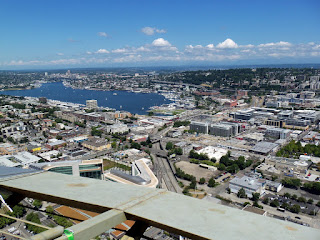
View From Atop The 510 Foot High Space Needle
Our first stop was in Seattle Washington where we planned to stay for 2 days prior to heading out for the rest of our trip. As it happens we lucked out and picked 2 of the most perfect weather days they've had in recent memory both days were sunny and warm with temperatures in the upper 80s.

Everyone Loves A Walk On A Sunny Day
We loved Seattle! The very first stop we made after checking into the Westin Hotel was to head on out to Pike's Brewery were we meet up fellow brewer and forum member Kenny Lee to sample some of Pike's best beers and grab a bite to eat. We ordered pitchers of Pike's regular IPA which we all really enjoyed followed by their Double IPA then their Dry Wit and their Kiltlifter Scotch ale before ordering and up some Scuttlebutt Amber (from Everett, WA.) from their guest tap. We ate and talked about beer, brewing and travel while drinking these amazing beers and downing some great bar food. Pike's is a must see when you're in town. We planed on sampling each of their beers and as it turned out we ordered full pitchers of each of them instead, what can I say we like beer!

Words Simply Cannot Describe The Wonders
Within days we would be viewing one of Earth's most impressive and beautiful places from the warmth and comfort of our cruise ship. The slow, peaceful and meandering visit to Alaska's Glacier Bay Park will forever be one of the coolest things I've ever been lucky enough to have experienced in my life. The table I sat at was located 140 feet above the waterline and only 50 feet from the nearest bar where they served up ice cold Alaskan Brewery Summer Ale and Amber Ale. Although I really liked their Pale Ale it was only available in the towns we stopped in, for some strange reason the ship's bars didn't stock it.

If Beer Is Proof That God Loves Us Then What Is This?
We spent the entire day and much of the early evening in our front row seats looking out at the grand vistas that appeared around every bend of the bay. Whenever something spectacular came into site we rushed outside to the deck rail to snap our pictures. Much of the time we found ourselves moving from one side of the ship to the other in order to get pictures of the scenery as we passed by. It was hard to believe that this 1000 foot deep bay our enormous ship was navigating through was solid glacier ice 250 years ago. All the glaciers that feed into Glacier Bay are in retreat except for one, which scientists say is actually growing 12 feet a year. Maybe someday that glacier will influence all the others to do the same and restore the bay to it's former glacier self.

Did Someone Say There's A Heat Wave?
At the height of our trip the time change was 4 hours earlier than east coast time and the sunset at 10:30 pm local time. Some of our shore excursions started at 6:00 pm and we had to be back on board the ship by midnight. In between all the beer sampling, time changes and the extended daylight hours we lost all concept of time somehow not knowing or caring about anything but what we were going to do next. In all honesty we found ourselves adrift in time, left alone by the rest of the world's problems of the day, to experience some of the most spectacular sites on earth. This my friends and fellow brewers was as close to Nirvana as anyone can ever come to expect and in so many ways one of the best vacations I've ever had.


Sunday, June 5, 2011

Screwys Recipe #57a - Screwy Pale Ale (All Grain)

After sampling this beer last week I thought it tasted so good that I brewed this exact same recipe again this past weekend. I was trying to decide what to brew and kept coming back to this Screwy Pale Ale because I think it's going to be a winner. So I emailed my order over to Joe early Sunday morning, drove out to pick it up and was brewing beer by lunchtime.

Marris Otter, Crystal 60 And Biscuit Malts

Size 5.00 gallons: Estimated IBU=65, SRM=14, OG=1.062, FG=1.015, ABV= 6.0%

I pitched White Labs WLP005 - British Ale Yeast™ directly into the 70F wort right after aerating it. I soaked the tubes in One-Step as an extra precaution against infection.


Recipe:
Click to download this recipe file for qBrew 
9.0 pounds Marris Otter Malt (UK)
1.75 pounds Crystal 60L
0.25 pounds Biscuit Malt (Belgium)

1 ounce Yakima Magnum (pellets)
2 ounces Kent Golding (UK) (pellets)
1 ounce Cascade (pellets)

1 - White Labs WLP005 - British Ale Yeast™

Aerate, pitch at 70° F and ferment at 68° F until final gravity is reached
Raise to 70° F over 2 days and rack to secondary fermenter
Cold condition secondary fermenter for 1 week at 34° F
Keg at 30 psi for 2-3 days and serve at 34° F

Infusion Mash at 156° F for 60 minutes.
Boil for 60-90 minutes.
Ferment at 68° F (18.8 °C).

The only real change I made in the ingredients was with my yeast selection, this time I was able to use some really fresh White Labs WLP005 - British Ale Yeast™ as opposed to the Safale S-04 Dry Ale Yeast I used last week. After soaking the new WLP005 tube in 70F One-Step I used an empty tube from an earlier brew to measure the yeast out into 2 tubes, one for each of my 2 fermenters.

2 For 1 Economy
Since I use the Mr. Beer fermenters and they hold around 2.5 gallons of wort I can use half of the yeast that's packaged for 5 gallon brews and still get a high cell count. I see this as another low risk way to save money on ingredients while maintaining quality.

  Click to download Screwy's latest qBrew database   


Directions:  
Infusion Mash: (Soak tun in 8 quarts of 170° F water for 20 minutes and dump it to preheat tun)
Heat 20 quarts of filtered water to 172° F
Pour 14 quarts of 172° F water into mash tun
Mix in 11.0 pounds of crushed grain mix at 70° F
Pour the remaining 172° F water to fill mash tun to 4.50 gallon mark
Stir water and grain mixture and adjust to 156°F and mash for 60 minutes
Fly sparge with 168° F strike water to set mash bed to 168° F
Lauter for 30 minutes adding 11.5 quarts of sweet wort to both 12 quart boil pots

Full Wort Boil: (Split these quantities between both boil pots)
Add 1 ounce Magnum hops with 60 minutes remaining to boil
Add 2 ounces Kent Goldings (U.K.) hops with 20 minutes minutes remaining to boil
Add 1/2 tablet WhirlFloc with 9 minutes remaining to boil
Add 1 ounce Cascade hops with 7 minutes remaining to boil
Use wort chiller to cool wort to 70° F

Primary Fermentation:
Use auto-siphon to rack wort from boil pots to fermenters
Fill the Mr. Beer fermenter with wort to just above the 8.5 quart mark
Aerate wort and pitch 1 tube White Labs WLP005 - British Ale Yeast™ at 68-70° F
Ferment to final gravity then raise to 70° F over next 2 days

Secondary Fermentation:
Cold condition secondary fermenter for 1 week at 34°F
Keg/Bottle:
Keg and force carbonate at 30 psi for 2-3 days at 34°F
Bottle prime and carbonate at 70° for 7-14 days

After lautering off a little over 5 gallons of wort I took a gravity reading of almost 1.020 proving to myself that they were still plenty of sugars available to be drawn off from my 11 pounds of grain. I got into the habit of taking gravity readings at 3 critical points during my brewing sessions, when I first begin to lauter, when I have finished lautering and after the boil just before pitching my yeast.


1.090 @ 70F Sample At Start Of Lauter
The initial sample I took showed 1.090 and tasted really sweet, no tannins there. I had 1 bad experience where my all grain batch turned out very astringent and I attribute that to sparging with too hot strike water and too much volume.

An Exhaust Fan Is Required To Remove Boil Vapors
  I recently installed an exhaust fan to remove the wort boil vapors from the basement where I do my brewing. At the opposite end of the basement I leave the window open to draw in fresh air from outside. I recommend that anyone who considers brewing beer indoors includes adequate ventilation in their plans. Removing the odors and hot vapors created during a typical brewing session will go a long way in keeping living area  healthy.

Doing Dual 2.5 Gallon Boils At Once Is Easy
  Since I brew indoors on my stovetop I split the 5 gallons of wort collected into two 12 quart pots so I can get them both up to full boil quickly.The trick to getting roughly same same OG in both pots during the lauter is to alternate between the 2 pots when filling them.


Fly Sparge Using A Stationary Diffuser Gives Great Results

I fly sparge and take at least 30 minutes to fill both boil pots with sweet wort. The new bracket I made to hold my sparge diffuser really worked out well for me. I was able to pour 168F strike water into the top of the mash tun without having to hold and balance the diffuser with one hand.


1.020 @ 70F Sample At End Of Lauter

After filling both boil pots with about 11.5 quarts of sweet wort I took another hydrometer reading to see how much sugar was still left in the 11 pounds of grains. This sample still tasted sweet, no tannins or astringent tastes were present, the reading was 1.020 which is above my 1.010 minimum threshold for lautering.


Transferring the cooled wort to the fermenters has become so easy I almost can't wait to use my auto-siphon when I brew, it works that well. The wort I rack to the fermenter is cleaner too, much of the trub is left behind in the boil pot so the wort that does make it into the fermenters is cleaner. During the boils I've also been ladling off a lot of the hotbreak and foam that accumulates on the top of the boiling wort.


Original Gravity Showed 1.060 @ 70F

My original gravity readings confirmed I came very close to hitting my target OG of 1.062 proving that my mash conversion efficiency was what I had expected. I pitched a 1/2 a tube of WLP-005 into each of the 2 sanitized Mr. Beer fermenters at 70F after aerating the wort into a foam.


Aggressive Fermentations Developed After 24 Hours
About 24 hours later both fermenters showed very active fermentation and a nice trub layer on the bottom, a sure sign that there would be more great tasting beer to come. While I keep an eye on these two latest batches of SPA this week I'll be also be bottling up the two previous batches I brewed on May 28th. 


The final gravity reading taken just before bottling came very close to my 1.015 target and after 2 days of getting the same 1.017 hydrometer reading it was time to bottle. 


1.017 Final Gravity Before Bottling
Bottling Day:

Re-purposed Sierra Nevada Bottle Rinse
Since I was able to make a connection where I can buy Sierra Nevada Pale Ale bottles that ship with free beer inside, I haven't been buying too many empty longnecks. I like the Sierra Nevada bottles because they are shorter and stubbier than the standard 12 ounce longnecks and are easy to tell apart.

After soaking the bottles in a mixture of OxiClean FREE and water for at least an hour I peel off the paper labels and scrap the remaining glue off with the edge of a plastic ruler. I let the bottles dry on the outside before putting my vinyl labels on them permanently. 


Bottles Filled With One-Step Soak For 10 Minutes
I used my priming calculator to determine how much pure cane sugar would be needed to carbonate 2.25 gallons of beer, the answer was 5 tablespoons. I filled a small pot with about a cup of filtered water and brought it to a boil. Then I stirred in the 5 tablespoons of pure cane sugar and let it boil for about 5 minutes.


5 Tablespoons Of Pure Cane Sugar And 1 Cup Of Water
I cooled the sugar 'syrup' and poured it into a sanitized keg that I used as my bottling bucket. Then I transferred the fermented beer from the primary fermenter to the bottling bucket, right on top of the sugar syrup so it mixed in well. 


Transfer Using A Short Length Of 5/16 ID Vinyl Tubing
Once the beer and sugar were in the bottling bucket I gently stirred the mixture for a minute using a sanitized spoon. The stirring helps evenly distribute the beer and sugar which will make the finished bottles have more consistent carbonation levels.


Bench Capper Made Short Work Of Capping The Bottles
I used a bottling wand and locking spigot to bottom fill each bottle and placed a sanitized bottle cap on each until I was ready to cap them all. The long arm and stable base of the capper made it very easy to cap a case of bottles once they were filled.

Bottling Sample Of My Screwy Pale Ale Recipe
The samples we tasted were really perfect having a nice hoppy character, somewhat sweet and that coveted biscuity finish. There was nothing harsh about this beer at all in fact the flavor, smell and aromas came together to make this a truly memorable beer. This will make for some good beer drinking come July 4th when the carbonation should be completed.


Screwy Pale Ale On July 1, 2011
Another winner in my book! This beer had a beautiful 14 SRM color that fell within the very upper limits of an English IPA beer style. There was a nice carbonation level that produced a creamy head of foam that lasted through the entire beer. The hops were prominent but not too overpowering, the IBU were about 5 points higher than the classic IPA style, and there was a nice biscuit finish. All in all this recipe gets my 2 beers up award and has earned a place in my standard recipe library as one to brew again. 
Saturday, October 30, 2010

Screwy's Recipe # 45 - Extra Special Strong Bitter (English Pale Ale)

 While browsing around the forums this week I noticed a post for a 3.5 gallon size recipe aptly named 'Extra Special Bachelor-Party' that's based on a Brewing TV episode of Jake's ESB recipe. Since I will soon have all six of my fermenters empty, after my upcoming bottling days, I figured I would scale that recipe down to fit a 2.13 gallon Mr. Beer batch and post it.

My Pipeline Consists Of Empty Bottles Now

 This recipe stood out among the others I've seen posted recently because it used the same type of hops for bittering, flavor and aroma. The recipe also uses steeping grains and DME which I also have been using lately for my last several brews with very good results. I haven't brewed this style of beer before and I figured it'll be a nice addition to my every growing recipe library.

A little research of the BJCP Style Guidelines showed my that this bitter English pale ale can be low to moderately hopped and also low to moderately malty with a moderately to strong caramel flavor. It went on to say that the hop bitterness and flavor shouldn't overpower the malty sweetness. 

 The carbonation for this style should not be too high, it should come in between 0.75 to 1.3 volumes, something to remember when priming your bottles for natural carbonation on bottling day. Since the residual Co2 of this fermented beer will already be about .83 volumes only a little less than 1/2 a teaspoon full of cane sugar will be needed to hit the higher end of the carbonation range.

  I always buy 2 pound bags of DME and limit my use of steeping grains in the majority of my recipes to 1/2 pound or less. In order to bring up the Original Gravity a bit closer to the style's upper limit while increasing the ABV percentage and adding some alcohol warmth, I added 1/2 pound of honey to the recipe. This late sugar addition should produce a slightly dry finish and work well with the extended DME boil time to produce some needed caramel sweetness.

  I selected Danstar Windsor dry yeast for the fermentation since I like using rehydrated dry yeast, I've found that it really takes off fast if done properly, and this yeast seems to fit in well with the English style recipe. To really suppress any diacetyl production I'll ferment this ale at 65F for at least 21 days before taking a sample for bottling.

 I used qBrew's default 'Extra Strong Bitter (English Pale Ale)' style guidelines to crunch the recipe's numbers.


Recipe: Size 2.13 gallons: Estimated IBU=40, SRU=12, OG=1.056, FG=1.014, ABV=5.5% 
2 pounds Muntons Light DME
1.0 ounce Fuggles pellet hops boiled for 60 minutes
1/4 ounce Fuggles pellet hops boiled for 20 minutes
1/2 pound Honey boiled for 10 minutes
1/4 ounce Fuggles pellet hops boiled for 7 minutes
11 grams Danstar Windsor yeast
Pitched at 65F and fermented at 65F

Directions:
Boil 10 quarts of filtered water (depending on brewpot size)
Stir in 1/2 lb. DME at rolling boil
Boil 1.0 oz. hops for 60 minutes
Boil 1/4 oz. hops for 20 minutes
Stir in 1 1/2 lbs. DME at 10 minutes then boil until hotbreak
Stir in honey resume boil for 10 minutes
Boil 1/4 oz. hops for 7 minutes
Use Screwy's Cooler until wort temperature cools to 65F
Pour cooled wort into fermenter keg and pitch yeast
Ferment at constant 65F temperature for 21 days

Thursday, June 10, 2010

Caribbean Lime Lager


Brewing: Caribbean Lime Lager
Features: clean, mellow and delicious (4.6% abv)
Price Range: $13.00


Overall Rating: Brewed On 12-Jun-2010


This smooth, mellow beer is slightly sweet, with just a kiss of lime. Finishes clean and dry. A bit of sunshine really brings out the flavor. Reggae music is optional. Yeah Mon!


Caribbean Lime Lager
Recipe:
1 Can Englishman's Nut-Brown Ale
1 Pouch Booster™
1 Packet Dry Brewing Yeast (under lid of beer mix)
1/4 Cup Brown Sugar
1/2 Cup Honey
2 Small Limes (with juice and grated zest)


Fermentation, Carbonation And Conditioning Times:
21 days for fermentation
21 days for carbonation
21 days minimum conditioning at 50-70F
02 days minimum in fridge

Fermentation: 12-Jun/03-Jul
(68-76F)
Carbonation : 03-Jul/24-Jul
(68-76F)
Conditioning: 24-Jul/14-Aug (55-70F)

Brewer's Comments:
This will be the first Caribbean style beer I have ever brewed. I sampled this brew with a friend today before bottling and it definitely had noticeable lime flavors. We agreed that this will make a nice refreshing drink on a hot summer day. I've added this recipe to my reorder list already, this will be one of my most frequently brewed warm weather beers.


Fermentation:

The ingredients used in this recipe require average fermentation and carbonation times in order to allow the yeast to work. I typically allow 3 weeks for fermentation at a constant 70F for all my beer recipes.


Carbonation:
Just as in the fermentation process your carbonation times will depend on the complexities of each recipe and the amount of additional ingredients that are added. As a general rule of thumb recipes containing many ingredients will take longer to carbonate than recipes with few ingredients.I let my bottles carbonate for at least 3 weeks before moving them down to the conditioning, or lagering room.


Conditioning/Lagering:
Conditioning, also known as Lagering the beer allows the beer's flavors to fully merge and mature in the bottle before drinking. In a basement, with a consistent year round temperature range of 50-65F, naturally brewed beer can be stored for up to 6-12 months as it will be preserved by the alcohol. Prior to drinking the beer should be refrigerated for 24-48 hours and served cold in a clean glass.